

Tiny cars, big question: Is there a place for microcars in Australia?
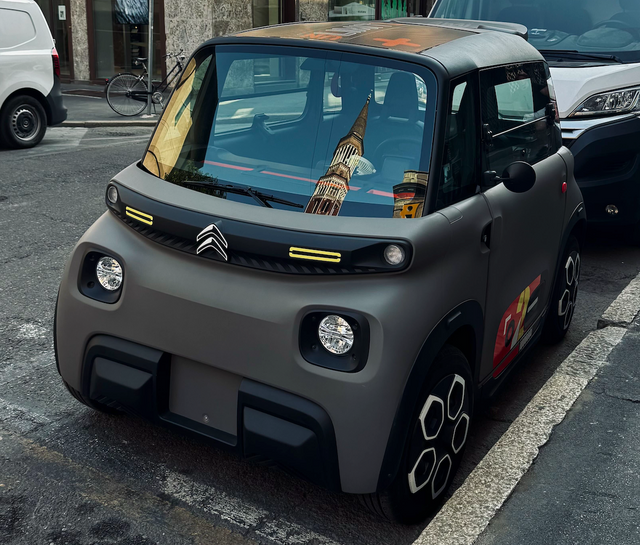
After travelling to Berlin for an annual eMobility conference, my better half and I turned the rest of the trip into a motorhead’s European pilgrimage - a day exploring Stuttgart’s motor museums, a Swiss grand tour via the Gotthard Pass, and finally on to Milan for the Monza F1 Grand Prix.
Yet, after spending days celebrating some of Europe’s fastest and most exotic machines, it was something at the opposite end of the automotive spectrum that unexpectedly captured our attention in Milan.
Tiny cars.
At first, we were delightfully intrigued by them. Then we started spotting them everywhere. Before long, we had fallen slightly in love with the idea.
The Fiat Topolino. The Citroën Ami. The impossibly charming Microlino - which, as it happens, comes from the same Swiss company behind the Micro scooters my boys have ridden for years.
They look like modern-day Micro Machines brought to life: compact, colourful and unapologetically designed for the city.
I’m not going to lie. I left Milan thinking two things...
“Absolutely, these could work in Melbourne or Sydney.”
And...
“I bloody want one.”
Not quite a car. Definitely more than a scooter.
Depending on whose definition you use, these vehicles sit at the very edge of micromobility - or just outside it.
Europe classifies them as quadricycles rather than conventional passenger cars. The Fiat Topolino and Citroën Ami fall into the lighter L6e category, while the faster and more capable Microlino is classified as an L7e heavy quadricycle.
The distinction matters.
The Topolino and Ami are purpose-built for short urban journeys. Each seats two people, is fully electric and is approximately 2.4 metres long and 1.4 metres wide.
Both have a top speed of around 45 km/h, a range of approximately 75 kilometres and a 5.4 kWh battery. They can be fully charged in about four hours - without needing a high-powered home charger. In their European form, a normal domestic electricity supply is enough.
The Microlino takes the concept further. At around 2.5 metres long and 1.5 metres wide, it remains tiny - but offers a top speed of 90 km/h and claimed ranges of 93, 177 or 228 kilometres, depending on its 5.5, 10.5 or 15 kWh battery - and weighs in at roughly halfa ton.
That makes it far more useful beyond the tight confines of a European city centre - and, arguably, the most viable of the three for Australian conditions.
Yeah, our country is BIG. But most of us don’t drive across Australia each day.
The immediate objection will be obvious:
Australia is too big for tiny cars.
Geographically, sure. But that misses the point.
Australia may be a continent-sized country, yet 90 per cent of our population lives in urban areas. Around two-thirds live in our capital cities.
Most Australians aren’t driving from Melbourne to Sydney each morning. We’re driving a few kilometres to work, the station, the shops, the gym, school or the local café - often alone, in vehicles designed to carry five or more people.
A microcar isn’t supposed to replace the family SUV, tow the caravan or take four kids and a Kaboodle down the coast.
It could replace some of the short journeys currently made in a two-tonne vehicle carrying one person.
That distinction is important.
In the right environment, microcars could provide a weather-protected alternative to scooters and motorcycles, while taking up substantially less road and parking space than a conventional car.
They may also have applications beyond private ownership - urban delivery fleets, car-sharing services, tourism precincts, local government fleets and last-mile business transport.
Then there’s parking
One of the cleverest features of vehicles such as the Microlino is their physical ability to park nose-in to the kerb.
Its front-opening door allows the driver and passenger to enter and exit without needing space beside the vehicle. In some European cities, multiple microcars can occupy the length normally consumed by a single conventional car.
That could be enormously useful in Melbourne and Sydney, where kerb space is becoming increasingly contested.
There is just one small problem - our current parking rules generally require vehicles to park parallel to the kerb unless signs or markings permit angle parking. Owning a car capable of cross-parking doesn’t automatically make cross-parking legal.
If Australia wanted to capture the full space-saving benefit, councils and state governments would need to create designated microcar parking areas or update the rules.
The technology alone won’t solve the problem. The city needs to accommodate it.
Would Australia even let them onto the road?
This is where the idea encounters its biggest obstacle.
Every new road vehicle supplied in Australia must comply with the relevant Australian Design Rules and be entered on the Register of Approved Vehicles. The ADRs cover safety, construction, anti-theft requirements and emissions.
Europe has established L6e and L7e classifications specifically for quadricycles. Australia does not appear to have a direct equivalent for these four-wheeled microcars. Our L-category framework is built around two- and three-wheeled vehicles, while a four-wheeled passenger vehicle is more likely to find itself assessed as a passenger car.
That potentially asks a 500-kilogram urban microcar to satisfy requirements designed around a conventional passenger vehicle.
Left-hand drive creates another complication.
It isn’t universally prohibited in Australia, but bringing a new LHD model to market at scale is very different from registering a rare or historic import. Under one specialist and enthusiast pathway, vehicles admitted using the left-hand-drive criterion must be converted to right-hand drive before they can be supplied to the Australian market. State registration rules then add another layer.
Fiat and Citroen’s defence of retaining the Topolino and Ami’s left-hand-drive configuration in the UK is wonderfully pragmatic - the vehicle is so narrow that there is little practical difference between where the driver and passenger sit in relation to the road.
Pragmatic may not be enough for an Australian regulator.
What about safety?
As much as modern-day Australia deserves its reputation as the great nanny state, safety is one question we can’t simply dismiss as regulatory overreach.
European quadricycles are not required to meet all the same crash-protection standards as conventional passenger cars. That reduced regulatory burden is part of what allows them to remain so small, light and relatively affordable.
They are enclosed, have four wheels and provide substantially more weather and impact protection than a scooter - but they are not miniature Volvos.
The comparison therefore matters.
If we compare a Topolino with a two-tonne SUV travelling at freeway speed, it will naturally look vulnerable. If we compare it with a scooter, motorcycle or e-bike making a short journey through a 30 or 40 km/h urban area, the proposition looks quite different.
That doesn’t mean Australia should wave them through without scrutiny. It means we should consider safety requirements proportionate to their intended use.
Again, pragmatic. Again, logical. Likely, a radical proposition... 👀
The 45 km/h Topolino and Ami would also be poorly suited to many Australian arterial roads, where surrounding traffic travels at 60, 70 or 80 km/h. They would need clearly defined operating environments.
The 90 km/h Microlino solves much of that speed differential, but its greater capability would reasonably bring higher safety expectations.
Can the economics stack up?
The European sticker price makes the concept appear compelling.
The Citroën Ami currently starts at £7,695 in the UK, while the Fiat Topolino starts at £8,995. That puts their basic purchase prices somewhere around the mid-to-high teens in Aussie dollars before anyone attempts to bring them here.
Unfortunately, currency conversion is not a landed retail price.
Add international freight, import costs, GST, local certification, compliance work, possible right-hand-drive engineering, inventory, spare parts, warranty support, insurance and a viable distribution or service network, and an apparent A$15,000-to-$18,000 vehicle could become considerably more expensive.
The Microlino is already a more premium product in Europe, making its Australian business case harder again.
At some point, the customer begins comparing the microcar with used conventional vehicles - or increasingly affordable full-sized EVs. If the price gap becomes too narrow, much of the logic disappears.
Australia is also a relatively small new-vehicle market located a helluva long way from European factories. An OEM would need confidence that local volumes justified the localisation investment plus support costs.
The strongest entry point may therefore be a fleet, car-share or controlled urban trial rather than an immediate nationwide retail launch.
What’s actually stopping them?
Could large automotive companies and their lobbyists have something to do with it? Perhaps. Major corporations undeniably have access and influence, but without evidence that anyone is actively lobbying against microcars, blaming them feels a little too convenient.
The more likely explanation is less sinister - and perhaps more frustrating - our regulatory system was built around established categories of cars, motorcycles and commercial vehicles. Microcars simply don’t fit neatly into any of them.
Add Australia’s small market, state-by-state registration requirements, institutional risk aversion and a tendency to demand local proof for concepts already operating overseas, and the commercial opportunity can be killed without anyone deliberately trying to kill it.
Australia says it aims to harmonise its vehicle standards with international regulations wherever possible.
Perhaps this is an opportunity to prove it.
So, is there a place for microcars in Australia?
I think there is - but unlikely under the rules and market structure we have today.
We shouldn’t blindly import Europe’s regulations, nor pretend these vehicles offer the same protection or capability as conventional cars.
But we also shouldn’t force every new form of mobility into a category designed decades ago and then declare the concept unviable when it doesn’t fit.
Australia could establish a nationally consistent microcar or quadricycle classification with:
- Appropriate minimum safety requirements
- Clear speed and power limits
- Defined licensing and registration rules
- Restrictions from freeways and unsuitable high-speed roads
- Designated microcar parking
- Proportionate insurance and registration costs
- Controlled trials in selected urban areas
Start with Melbourne, Sydney or Brisbane. Test them in real conditions. Collect the safety, usage and congestion data. Let consumers decide whether the proposition works.
They won’t suit everyone. They won’t replace every car. And they certainly won’t solve Australia’s transport problems by themselves.
But they could give Australians another practical, efficient and genuinely enjoyable way to move around our cities.
After a few days watching them silently zip through Milan, I’m convinced the idea deserves more than an automatic “that wouldn’t work here”.
And yes - I still bloody want one.
Charge on, legends! ✌️